Vassar's first sport
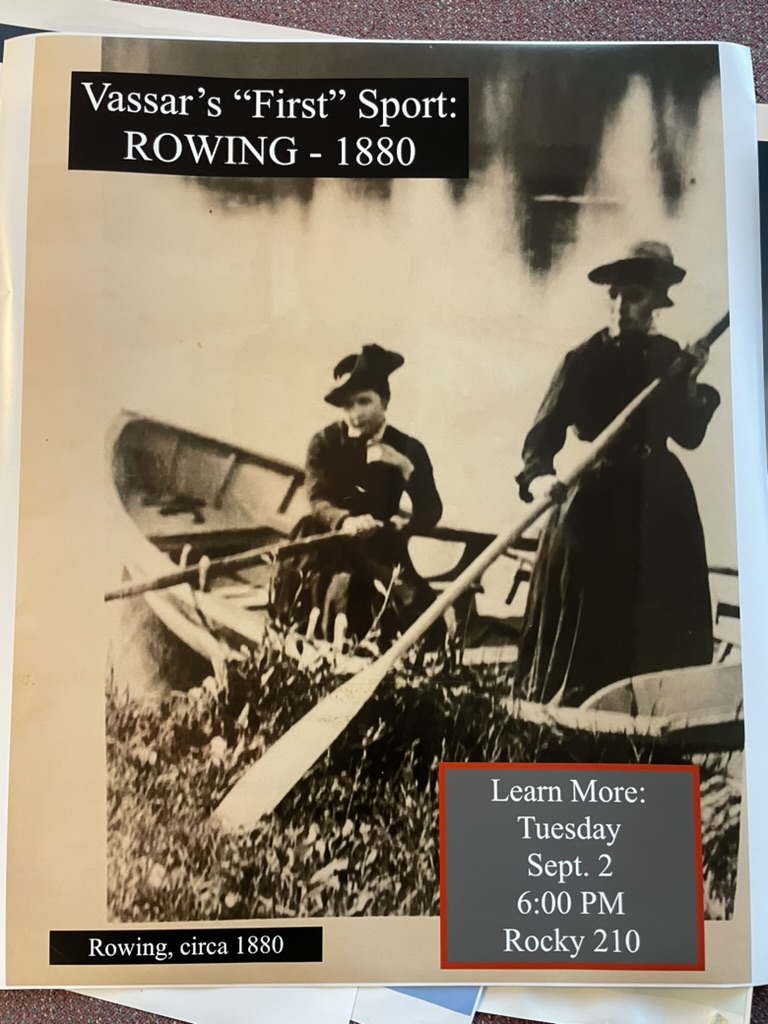
Rowing at Vassar is older than almost anything else in the College's athletic life. Vassar Female College opened its doors on September 26, 1865, and within seven months students were organizing to get outside. On April 20, 1866, Annie Glidden, Class of 1869, wrote to her brother: "They are getting up various clubs now for outdoor exercise. They have a floral society, boat clubs and baseball." The letter is preserved in A Documentary Chronicle of Vassar College, which notes that it is believed to be the first reference to American women playing baseball. The boat clubs are mentioned in the same breath.
The Vassar Encyclopedia's history of early athletics confirms that in 1866 "the students founded croquet, archery, and rowing clubs," at a time when the College encouraged sport "even if it doubted the merits of competition." Matthew Vassar believed physical activity would bring balance to his students' lives. The poster above dates its photograph to 1880. We have not found a written source for that particular year, but the written record puts boat clubs at Vassar even earlier, in the College's first academic year.
That early rowing happened on campus water, not on the river. Writing in Scribner's Magazine in 1898, in an essay reprinted by the Vassar Encyclopedia, Margaret Pollock Sherwood wrote that the college girl "is roused to physical activity. There is rowing on the lake." The Hudson was part of student life too, through ferry crossings and river excursions, but she was plain about the rules: "Rowing on the river is not permitted." (That lake was not today's Sunset Lake, which was not finished until 1912.) It would take most of another century for Vassar crews to make the Hudson their home.
Watching from the shore
Vassar did know the college crews who came to the river. On June 6, 1895, less than three weeks before the first intercollegiate regatta at Poughkeepsie, President and Mrs. Taylor joined Mr. and Mrs. Harris S. Reynolds in hosting a reception at the Reynolds home on Washington Street for the Vassar senior class and the visiting crews from Columbia and Penn. According to the College chronicle, The New York Times counted 96 seniors and some 40 crew men, and by the end of the evening the Penn oarsmen's colors had "changed owners."
A program is born on the Hudson
Vassar became coeducational in 1969, as the College's sesquicentennial history of athletics recounts. The modern rowing program came later. As Vassar Athletics tells it, "Rowing at Vassar began with one young coach, two old wooden shells, and a handful of students who were eager to spend some time on the Hudson River." That was the fall of 1983, and the founder was Scott Sanford, then principal of Spackenkill High School, coaching part-time. He called rowing "the champagne of sports." Ed Clark helped by coaching the women's squad.
The first crews rowed out of F.D. Roosevelt High School's boathouse in two donated wooden shells. As the team grew, A.C. Dutton Lumber Corp. donated a small space next to the Marist College boathouse, about 2,000 meters downriver, and Sanford and his rowers built their own docks. In 1994–95, under President Frances Fergusson, the College acquired adjacent riverfront property with three buildings to renovate. Today's facilities include the boathouse, a clubhouse used for video review, and a launch house, plus an indoor erg room in Kenyon Hall on campus.
Fergusson looked back on that decision when she was inducted into the Vassar Athletics Hall of Fame in June 2025. Describing how the College rebuilt its athletics after she arrived in 1986, she wrote: "We purchased the land along the Hudson for crew, an historic sport for Poughkeepsie."
Varsity years and beyond
Rowing earned varsity status in 1997. Head Coach Mike Alton arrived in 2000 and turned the program's focus toward eights. The results followed: a third-place varsity eight at the 2001 ECAC Championships and a national top-20 ranking, a win in the club eight at the 2002 Head of the Schuylkill, and in 2004 a sixth-place finish for the women's varsity eight at ECACs, which Vassar Athletics called the highest eights placement in program history. Later highlights include a men's double that medaled at the 2012 Head of the Charles as the fastest undergraduate boat in its event.
In the fall of 2010 rowing moved to club status, though the sesquicentennial history notes it "was retained within the athletics program." In 2019 a rower writing in The Miscellany News called it "a club varsity sport": the team practices and competes like the varsity programs, with less funding and less attention. She also described the team's annual Ergathon during the "27Brew2" challenge, when the rowers "rallied together to reach over 600 donors and raise over $25,000." The crews race on. In the spring of 2024, for example, the men's varsity eight raced at the National Invitational Rowing Championships in Worcester, and both squads posted wins against Union.
Coaches by era
Here the record is thin. Scott Sanford founded the program, with Ed Clark coaching the women; Mike Alton was hired in 2000; Rodney Mott is listed as head coach on the Athletics history page; and Stephanie Ricker was head coach in 2012 and 2013. Peter Wells came to Vassar in November 2018, after 35 years as head men's coach at Williams College, where his crews won eight conference championships and eight New England titles. He was named head coach of both the men's and women's squads in June 2019. We don't know the full sequence of coaches or their dates, and we haven't found a published list of notable Vassar rowers. Both are gaps we hope alumni can help fill.
The Poughkeepsie Regatta
Long before Vassar put a shell on the river, this stretch of the Hudson was the center of American rowing. The Intercollegiate Rowing Association was founded in 1891 by Cornell, Columbia and Penn, and on June 24, 1895, it held its first championship regatta at Poughkeepsie. Columbia won; Penn's boat, row2k notes, sank. Marist's archivists explain why the site was chosen: a relatively straight four-mile stretch of river, sloping banks that let spectators see the race, room to run an observation train along the course, and neutral water.
The event became known simply as the Poughkeepsie Regatta, and it grew into a national spectacle. By 1899 the observation train that followed the race along the west shore, "a moving grandstand" of flatcars fitted with seats, ran to 48 cars. Tens of thousands of spectators came to town each June, hundreds of boats and yachts moored along the river, and Scenic Hudson notes that Navy destroyers sometimes attended too. The crowds included Franklin and Eleanor Roosevelt, Theodore Roosevelt, J. Pierpont Morgan, the Astors and the Vanderbilts. Poughkeepsie and Highland, on opposite banks, housed the crews in homes, boarding houses, schools and hotels.
Early on, Cornell set the pace. Under Charles "Pop" Courtney, whose "Courtney stroke" became famous, Cornell dominated the regatta before World War I and won all three races several times between 1900 and 1912. Crews from the West Coast came later. Washington first raced at Poughkeepsie in 1913 and won the varsity race in 1923, and California's eight won Olympic gold in both 1928 and 1932, HistoryLink recounts.
The course and its landmarks
Crews raced south toward Poughkeepsie from the Hyde Park end, near today's Culinary Institute of America campus. On the finish line, the record is inconsistent. Scenic Hudson places the historic finish at the Mid-Hudson Bridge, while The Miscellany News describes the four miles as running to the railroad bridge that is now the Walkway Over the Hudson. The railroad bridge was completed on January 1, 1889, and after a 1974 fire it reopened in 2009 as a pedestrian park, 212 feet above the river. The Mid-Hudson Bridge opened on August 25, 1930, with then-Governor Franklin Roosevelt and Eleanor Roosevelt at the ceremony.
Regatta Row
For years, crews stored their boats in long wooden plank sheds built by local citizens; none of those survive. Columbia bought property in 1912 for a boathouse and quarters on the west shore, north of Highland. It later became a private residence, and what happened to it after the 1990s is unknown.
Between 1931 and 1938 the Poughkeepsie Regatta Association built permanent boathouses on the east bank on what became known as "Regatta Row," off Waterworks Road in the Town of Poughkeepsie. They were the MIT/Washington boathouse (1931) and dining hall (1936), the California boathouse (1932), and the Cornell boathouse, completed in June 1938 as a WPA project. The MIT/Washington boathouse was built for MIT and given to Washington in 1936. Local high school crews used it after the regatta left, until it burned to the ground on May 6, 1957, despite a Coast Guard fireboat's efforts. The California boathouse came down in the late 1970s. The Cornell boathouse is the only one left. (Marist's own accounts differ slightly on which schools had houses on the Row; one also lists Wisconsin.)
1936: the Boys in the Boat
On Monday evening, June 22, 1936, the University of Washington won the freshman, junior varsity and varsity races at Poughkeepsie, a sweep no school had managed since Cornell in 1912. The varsity eight covered the four miles in 19:09 3/5, coming from behind to take the title, according to the University of Washington's own history. As HistoryLink quotes it, The New York Times wrote: "Washington won all three races on the Hudson River today … There can be no higher tribute paid the youngsters from the Pacific Northwest than that simple statement of fact."
Poughkeepsie was not the Olympic trials, though it is sometimes remembered that way. The trials came on July 5 on Lake Carnegie at Princeton, where the same crew again came from behind to win. On August 14, in front of some 75,000 spectators at Grünau outside Berlin, with Hitler watching from a balcony, it took the gold medal, finishing ahead of Italy and Germany with the top three boats separated by about a second.
That crew, and oarsman Joe Rantz in particular, became the subject of Daniel James Brown's 2013 book The Boys in the Boat and of George Clooney's 2023 film. Vassar crews train today on the same water where that season was won.
Why the regatta left
The regatta was interrupted by both World Wars and skipped 1933 during the Depression. It returned after World War II with parades and a regatta queen, but, as Marist's archivists put it, the celebrations "did not meet the crews' needs for additional boathouses and more." Other accounts point to the river itself. Hudson Valley Magazine says organizers moved to a lake in Ohio "where there was no river tide to affect the race's start dates and times," and a local history by Peter Klose cites "the difficult weather and tidal conditions of the Hudson." After 1949 the IRA left Poughkeepsie for Marietta, Ohio, in 1950, and then Syracuse.
Rowing on this reach of the river did not stop. According to FDR Crew's history, local high school crews began racing here in 1950, and the Mid-Hudson Rowing Association ran the Mid-Hudson Invitational Regatta from 1950 to 2000.
Keepers of the history
In 1976 the Poughkeepsie Journal drew attention to the condition of the surviving Regatta Row boathouses, and Marist stepped in to care for them. Marist's archive page on the Cornell boathouse gives 1976, while a Marist news story says it was acquired in 1977 under an agreement that let local high school crews row from it until 2002. Marist restored the boathouse in 2009, and it now stands in Longview Park as an event space and overflow shell storage. The Hudson-Fulton-Champlain Quadricentennial regatta that year brought crews including Columbia, Cornell, Navy, Penn, Syracuse, Army, Marist and Vassar back to the historic water.
Marist's Archives and Special Collections also maintains the Poughkeepsie Regatta Collection. According to Marist's account of the collection, it began in the early 2000s, during the boathouse restoration, with a few programs, artifacts and news articles. It has grown since 2013 through newspaper research, images, film footage and donated items. In May 2021 Marist launched an online exhibition drawing on more than 1,900 photographs, documents and objects. The Poughkeepsie Regatta, 1891–1949 is the best place to start for anyone who wants to see what race day looked like.
Our boathouse today
Vassar Athletics describes the rowing complex as four miles from campus on the Hudson. It sits on North Water Street, and Rhinebeck Crew's directions send drivers right past the Vassar boathouse to the Hudson River Rowing Association's community boathouse next door. The HRRA was formed by local high school coaches. They worked with Marist, Vassar, Dutchess County, the City of Poughkeepsie and the Mid-Hudson Rowing Association to build a boathouse for scholastic and adult rowing. It opened in 2006, and today it is home to eight regional rowing programs, run by volunteers.
The old course has come back to life, too. The HRRA welcomed back a Poughkeepsie Regatta in October 2008, and after the 2009 Quadricentennial race there was a repeat in 2010. Accounts differ on when the current series began. In 2025 HRRA and the Mid-Hudson Rowing Association co-sponsored a three-mile race from the Culinary Institute to the Mid-Hudson Bridge on October 4, and Vassar crews have raced in past editions.
The history is close at hand. In September 2025, Vassar's Alum Rowing Regatta and Celebration Weekend honored Joe Rantz, with his daughter Judy Willman and granddaughter Jennifer Huffman as guests. Jennifer rowed twice that weekend with Vassar students and alumni. "My hope was to have Jennifer row on the water her grandpa did," Coach Wells said. "For me, there's no place in the U.S.—and maybe the world—more sacred to rowing than here in Poughkeepsie."
What comes next
Vassar rowing's own history is still mostly unwritten. We know the outline, but not the crews, the coaches in every era, the names on the old shells, or the photographs sitting in alumni closets. We would like to gather those stories and images in one place, and in time help build something larger: a shared record of rowing on this water, from the Regatta Row era to the present, perhaps one day a rowing history museum for the Mid-Hudson. That starts with what you remember.
- 1865Vassar Female College opens, September 26.
- 1866Students found boat clubs, along with croquet, archery and baseball clubs.
- 1889The Poughkeepsie railroad bridge, now the Walkway Over the Hudson, is completed.
- 1891Cornell, Columbia and Penn found the Intercollegiate Rowing Association.
- 1895A Poughkeepsie reception on June 6 brings Vassar seniors together with the visiting Columbia and Penn crews; the first IRA regatta is rowed on June 24.
- 1898Scribner's reports "rowing on the lake" at Vassar; the river is off limits.
- 1899The observation train reaches 48 cars.
- 1930The Mid-Hudson Bridge opens, August 25.
- 1931–38Regatta Row boathouses built; the Cornell boathouse is completed in 1938.
- 1936Washington sweeps Poughkeepsie on June 22, wins the Olympic trials at Princeton on July 5, and takes Olympic gold in Berlin on August 14.
- 1949The last IRA regatta at Poughkeepsie; the championship moves to Marietta, Ohio, in 1950.
- 1957The MIT/Washington boathouse and dining hall burn, May 6.
- 1969Vassar becomes coeducational.
- 1983Scott Sanford founds the modern Vassar rowing program.
- 1997Rowing earns varsity status.
- 2006The HRRA community boathouse opens next door.
- 2009Marist completes the Cornell boathouse restoration; Vassar races in the Quadricentennial regatta.
- 2010Rowing becomes a club sport within Vassar Athletics.
- 2019Peter Wells named head rowing coach.
- 2021Marist launches its online Poughkeepsie Regatta exhibition.
- 2025Alum Rowing Regatta and Celebration Weekend, honoring Joe Rantz.
Help us write the rest
Do you have photos, race results, programs, blades, or stories from your years on the water? Did you row in the Dutton Lumber days, or know who coached which crews? Please send them to brian@briantormey.com. We will credit everything we use, and we would especially like to hear from alumni of the 1980s and 1990s.
Sources and further reading
- Vassar Athletics, "History of Vassar Rowing." vassarathletics.com
- Vassar Athletics, "Rowing Complex." vassarathletics.com
- Vassar Athletics, "Rowing Erg Room." vassarathletics.com
- Vassar Athletics, "Wells Officially Named Vassar Head Rowing Coach" (June 2019). vassarathletics.com
- Vassar Athletics, "Men's Rowing Earns Medal at Head of Charles" (October 2012). vassarathletics.com
- Vassar Athletics, "Vassar Rowing Competes at Head of the Charles" (October 2013). vassarathletics.com
- Vassar College, "Vassar's Rowing Crew Hosts Alum Regatta and Celebration." vassar.edu
- Vassar College, "Vassar Honors Inaugural Round of Athletics Hall of Fame Inductees" (June 2025). vassar.edu
- Vassar College, "May–June 2024 Athletics Roundup." vassar.edu
- Vassar College, "The History of Athletics and Physical Education at Vassar College," 150 Years. 150.vassar.edu
- A Documentary Chronicle of Vassar College, 1860–1869. chronology.vassarspaces.net
- A Documentary Chronicle of Vassar College, 1890–1899. chronology.vassarspaces.net
- Vassar Encyclopedia, "Athletics, 1865–1945." vcencyclopedia.vassar.edu
- Vassar Encyclopedia, "Undergraduate Life at Vassar College (1898)," Margaret Pollock Sherwood, Scribner's Magazine. vcencyclopedia.vassar.edu
- Vassar Encyclopedia, "Sunset Lake." vcencyclopedia.vassar.edu
- Amanda Su, "Why We Play: Amanda Su, Rowing," The Miscellany News (February 2019). miscellanynews.org
- The Miscellany News, "Poughkeepsie Regatta pays homage to historic race" (October 2025). miscellanynews.org
- Marist Archives and Special Collections, "The Poughkeepsie Regatta, 1891–1949" (online exhibit). exhibits.archives.marist.edu
- Marist Archives, "About the Regatta." exhibits.archives.marist.edu
- Marist Archives, "Crew Quarters and Boathouses." exhibits.archives.marist.edu
- Marist Archives, "Boathouses: Plank." exhibits.archives.marist.edu
- Marist Archives, "Columbia Boathouse." exhibits.archives.marist.edu
- Marist Archives, "Regatta Row." exhibits.archives.marist.edu
- Marist Archives, "MIT/Washington Boathouse." exhibits.archives.marist.edu
- Marist Archives, "Cornell Boathouse." exhibits.archives.marist.edu
- Marist Archives, "Cornell University." exhibits.archives.marist.edu
- Marist Archives, "1936" and "University of Washington." exhibits.archives.marist.edu; exhibits.archives.marist.edu
- Marist Archives, "About the Collection." exhibits.archives.marist.edu
- Marist University, "New Online Exhibition Will Explore the Rich History of the Poughkeepsie Regatta" (May 2021). marist.edu
- Marist University, "A New Era for the Historic Cornell Boathouse." marist.edu
- John Caldbick, "The 1936 Berlin Olympics and the Washington Huskies' Road to Rowing Glory," HistoryLink.org Essay 22823. historylink.org
- University of Washington, "Pulling together," Be Boundless. washington.edu
- Scenic Hudson, "The Starry Poughkeepsie Regatta (and the Real-Life Boys in the Boat)." scenichudson.org
- row2k, "The Intercollegiate Rowing Association Regatta." row2k.com
- Hudson Valley Magazine, "Then & Now." hvmag.com
- Peter Klose, "The Return of River Rowing." kloselaw.com (PDF)
- Wikipedia, "Poughkeepsie Regatta." wikipedia.org
- Wikipedia, "Intercollegiate Rowing Association." wikipedia.org
- Wikipedia, "Mid-Hudson Bridge." wikipedia.org
- Wikipedia, "The Boys in the Boat." wikipedia.org
- Walkway Over the Hudson, "Our Story." walkway.org
- Hudson River Rowing Association, "About Us." hudsonriverrowing.org
- Mid-Hudson Rowing Association, "Our History." midhudsonrowing.org
- Mid-Hudson Rowing Association, "POK Regatta." midhudsonrowing.org
- FDR Crew, "History." fdrcrew.org
- Rhinebeck Crew, "HRRA Boathouse Directions." rhinebeckcrew.org